News › Transfer Pumps
Why Your Diesel Pump Won't Prime
(And Other Flow Problems Solved)
A pump that spins but delivers nothing is almost never a failed pump. It is drawing air. Here's the order to check things in.
- Air Leaks
- Suction Lift
- 10-Step Diagnostic
- Flow Problems
A diesel transfer pump that won't prime is almost never a failed pump. In the overwhelming majority of cases it is drawing air on the suction side — through a loose fitting, an unsealed thread, a cracked hose or a suction lift that is simply too high. Work through the checks in order and you will find it, usually within ten minutes.
The instinct when a pump stops moving fuel is to suspect the pump. It is the expensive part, it is the part with moving components, and it is the part that makes the noise. But a self-priming vane pump has to pull air out of the suction line before it can pull fuel through it, and anything that lets air back in means it never gets there — the pump spins, sounds busy, and delivers nothing.
This guide covers how priming actually works, a diagnostic sequence to run in order, and the other flow problems that show up on site: weak flow, pulsing, cavitation noise, nozzles that keep clicking off and meters that read wrong.
2–3 m Practical dry suction lift for a typical self-priming vane pump
No. 1 Suction-side air leaks — more common than every other cause combined
10 Checks to run, cheapest and most likely first
Last Where the pump itself belongs on the suspect list
The Mechanism
How a transfer pump primes
Most diesel transfer pumps are self-priming rotary vane pumps. Inside the housing, a rotor carries sliding vanes that sweep fuel around an offset chamber. On the inlet side the space between the vanes expands and creates suction; on the outlet side it contracts and pushes fuel out.
Two things follow from that, and they explain nearly every priming fault.
Fact 1
The vanes seal against liquid, not air
Fuel fills the clearances between vane, rotor and housing and makes the seal effective. Bone dry, the pump churns air past its own vanes and never develops enough vacuum to lift anything.
Fact 2
Suction is limited, and lower than expected
The pump lowers the pressure in the line so atmospheric pressure pushes fuel up to it. That sets a hard ceiling — in practice roughly 2 to 3 metres of dry lift, and less once hose losses, a strainer, warm fuel or altitude are allowed for.
Manufacturers state a maximum suction lift for a reason — check yours, and treat it as an absolute ceiling rather than a target. Everything below is a variation on one of those two facts.
Diagnostic
The ten-step diagnostic, in order
Run these in sequence. Each one is quicker than the one after it, and the order is deliberate — the common causes are at the top.
1. Is there actually fuel above the pickup?
Obvious, and worth thirty seconds. Check the level, and check where the suction pickup sits relative to it. A pickup deliberately set above the tank floor — which is good practice, to avoid drawing sediment and water — will lose prime well before the tank reads empty. A gauge that reads a quarter full does not guarantee the pickup is submerged.
2. Is the suction line airtight?
This is the answer more often than everything else combined. The suction side is under vacuum, so a leak does not drip — it draws air in silently, and there is nothing to see on the outside.
Check in this order
- Every threaded fitting on the suction side. Tapered threads need thread sealant or PTFE tape rated for fuel. A fitting that is merely tight is not necessarily sealed.
- Hose clamps — one clamp on a barbed fitting that has relaxed over a summer is a classic.
- The hose itself — look for cracking near the fittings and at any point where it flexes or has been kinked. A hose that has gone hard is a hose that has stopped sealing.
- The suction hose's rating. Suction hose must resist collapse under vacuum. A length of discharge hose pressed into service on the inlet will pinch shut and behave exactly like a blockage.
- Filter housings and drain plugs on the suction side — bowl seals and drain taps are frequent culprits.
- The foot valve or check valve, if fitted — one that no longer holds lets the suction line drain back between uses, so the pump re-primes from dry every single time.
A quick test: if the pump primes when you shorten the suction line and connect it directly into a drum, the leak is in the section you removed.
3. Is the pump body wet?
If the pump has been serviced, moved, run dry or sat unused, prime it. Pour a small amount of clean diesel into the pump body or the suction port to wet the vanes, then start it. Do not run a dry pump for extended periods while you work on the problem — dry running destroys vanes and seals faster than almost anything else you can do to it.
4. Is the suction lift too high?
Measure the vertical distance from the fuel surface — the lowest working fuel level, not the full level — to the pump inlet, and compare it to the manufacturer's stated maximum. If you are close to the limit, the pump may prime with a full tank and refuse as the level drops, which is a maddening intermittent fault to chase.
The fix is to move the pump closer to the fuel, not to buy a bigger pump. Where possible, mount the pump at or below the fuel level so it is flooded rather than lifting.
5. Is the suction line too long, too narrow or too restricted?
Every metre of hose, every elbow and every fitting adds resistance, and on the suction side resistance eats directly into your available lift. Keep the line as short and straight as practical, do not undersize it — it should be at least the diameter of the pump inlet — and avoid high points, because a loop that rises above the inlet traps an air pocket the pump has to clear every time. The relationship between hose diameter and flow is covered in our flow rates guide.
Diagnostic, continued
Steps six to ten
6. Is the strainer or foot valve blocked?
Inspect the inlet strainer. Debris, rust flakes, tank sealant, thread tape offcuts and the remains of old hose all end up there. A partially blocked strainer will let a pump prime slowly and then run weakly — which reads as a tired pump.
7. Is a filter on the wrong side of the pump?
Filtration belongs on the discharge side for most transfer setups, or on the suction side only where the pump manufacturer specifically allows it and the element is sized not to restrict inlet flow. A fine filter on the suction line strangles the pump. If a previously working setup stopped priming after a filter change, check the micron rating that went in against the one that came out — filtration elements are easy to substitute with a finer equivalent by accident.
8. Is the bypass or check valve stuck?
Most transfer pumps have an internal bypass valve that returns fuel to the inlet when the nozzle is closed, protecting the pump from dead-heading. If it sticks open, fuel circulates internally instead of going out the discharge — the pump runs, warms up and delivers little or nothing. It is usually accessible, and usually stuck because of debris or varnish rather than damage.
9. Is it turning the right way, and are the vanes intact?
Rotation. A DC pump wired in reverse polarity, or a three-phase pump with two phases swapped, will run backwards. It will sound normal and pump nothing. Check the direction arrow on the housing.
Vanes. Vanes wear, chip and occasionally stick in their slots — usually as a consequence of running dry, of particulate contamination, or of water in the fuel. Worn vanes show up first as reduced flow and a pump that primes reluctantly, and eventually as no prime at all. Vane replacement is a routine service item on most transfer pumps.
10. Is the pump getting full voltage under load?
Last on the list because it presents as weak flow more often than as no prime, but a badly undervolted pump will not develop the vacuum it needs.
Measure voltage at the pump terminals while the pump is running, not at the battery. Undersized or over-long cable, corroded terminals, a tired battery or an inadequate isolator will all drop voltage under load. A 12V pump seeing 10.5V is doing a fraction of its rated work. The cable sizing and voltage-drop detail is in our 12V vs 24V vs 240V guide.
Air Leaks
Finding an air leak you cannot see
If the sequence points at an air leak but you cannot find it:
Four ways to locate it
- Watch a clear section. A clear inline strainer bowl or a sight glass on the suction side will show a stream of bubbles when the pump is running. Bubbles mean air is entering upstream of that point.
- Isolate by shortening. Connect a short, known-good suction hose straight into a drum of fuel. If it primes, the fault is in what you bypassed. Add sections back one at a time.
- Pressurise the suction line. With the line disconnected from the pump and blanked at the pickup, apply low-pressure compressed air and use soapy water on fittings. Leaks that are invisible under vacuum are obvious under pressure. Keep the pressure low, keep it away from the tank, and do it with the line clear of fuel.
- Watch what happens when it sits. If the pump primes fine but loses prime overnight, the leak or a failed foot valve is letting the column drain back. That is a different fix from a leak that stops it priming at all.
Flow Problems
The other flow problems, and what causes them
The pump runs but flow is weak
In rough order of likelihood: voltage drop under load (the most common cause on 12V and 24V setups); restricted suction from undersized hose, a blocked strainer or a partly collapsed suction hose; worn vanes, which decline over months rather than suddenly; a bypass valve partly stuck open; and discharge-side restriction — an undersized or excessively long delivery hose, a clogged filter, a partly closed valve, or a nozzle with a smaller spout than the pump's rating.
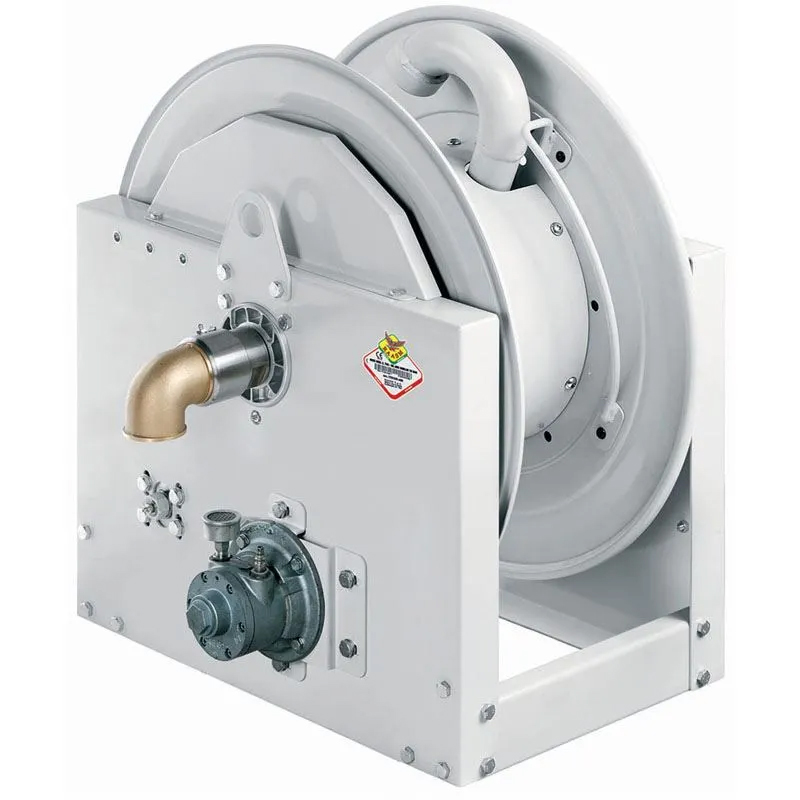
A hose reel that is undersized for the flow belongs on that list too. The reel's internal diameter and swivel are part of the flow path, not just storage — check the rating when you specify one from the hose and hose reel range.
The flow pulses or surges
Air. Almost always a small suction-side leak that is letting slugs of air through rather than a steady stream, or a strainer blocked enough to starve the pump intermittently. Occasionally it is the bypass valve chattering.
The pump whines, rattles or sounds like it is pumping gravel
Cavitation — the pressure at the pump inlet has fallen low enough for vapour bubbles to form in the fuel and then collapse violently inside the pump. Causes are all on the suction side: lift too high, line too long or too narrow, strainer blocked, or fuel too warm. It is not a cosmetic problem. Cavitation erodes vanes and housings, and a pump left to cavitate will not last.
The nozzle keeps clicking off
An automatic fuel nozzle shuts off when back pressure at the spout tells it the tank is full. It will do that prematurely when the spout is too far into a filler neck with a restricted vent, when flow rate is too high for the receiving tank's vent, when the nozzle's sensing port is dirty or partly blocked, or when the delivery hose is kinked or the reel swivel is restricted. Start with the receiving tank's vent — it is the cause far more often than the nozzle.
The pump will not shut off, or cycles constantly
On automatic setups this is usually a pressure switch or bypass adjustment rather than a pump fault. On manual setups, check that the nozzle is fully closing and that no bypass path is left open.
The meter reads wrong
Air in the line is the first suspect — a flow meter measures what passes through it, and air passing through registers as volume. Fix the priming problem and re-check the meter before condemning it. Beyond that: meters drift with wear and need periodic calibration, and a meter installed too close to a pump outlet or an elbow may see turbulent flow it was not designed to measure accurately.
Installation
Setting a pump up so it does not do this again
| Do this |
Why |
| Mount the pump as close to the fuel as possible, ideally flooded |
Removes suction lift from the equation entirely |
| Size the suction line at or above the pump inlet diameter |
Suction-side restriction costs you lift you cannot spare |
| Use hose rated for suction, not just for pressure |
Discharge hose collapses under vacuum |
| Seal every suction thread with fuel-rated sealant or tape |
Air leaks are the single biggest cause of priming failure |
| Fit a foot valve or check valve on a lifted suction line |
Keeps the line full so the pump does not re-prime from dry |
| Fit an inlet strainer and clean it on a schedule |
Cheaper than vanes |
| Put fine filtration on the discharge side |
Protects the equipment without strangling the inlet |
| Size cable for the run length and check voltage at the pump under load |
Voltage drop masquerades as a worn-out pump |
| Never run the pump dry |
Dry running is the fastest way to destroy vanes and seals |
Agriculture Transport Civil & Construction Mining Workshops Marine
Replacement
When it is genuinely the pump
Replace or rebuild when you have eliminated the suction side and the electrical supply, and one of these is true:
Signs the pump itself is finished
- Vanes are visibly worn, chipped or sticking in their slots
- The housing shows cavitation erosion — pitted, eroded surfaces around the inlet
- The shaft seal is weeping fuel
- The motor is drawing heavily, running hot, or has failed bearings
- The pump has been run dry, or has been passing water or heavy particulate for some time
At that point, choose the replacement against the job rather than replacing like for like — flow rate, duty cycle and power source are the three decisions, and they are covered in the 12V vs 24V vs 240V guide and the flow rates guide.
FAQ
Frequently asked questions
Why won't my diesel transfer pump prime?
In most cases it is drawing air on the suction side — an unsealed threaded fitting, a loose hose clamp, a cracked or hardened suction hose, or a foot valve that no longer holds. The other common causes are a suction lift higher than the pump's rating, a dry pump body whose vanes cannot seal, and a blocked inlet strainer. Check the suction line for air leaks first; it is the answer more often than everything else combined.
How high can a diesel transfer pump suck fuel?
Less than most people expect. A typical self-priming vane pump manages a dry suction lift of roughly 2 to 3 metres with diesel, and less once hose length, elbows, a strainer, warm fuel or altitude are taken into account. Always work to the manufacturer's stated maximum suction lift, and mount the pump as close to the fuel level as you can — ideally below it, so the pump is flooded.
Do I need to prime a new diesel pump before using it?
Usually yes. A rotary vane pump seals against liquid, so a completely dry pump cannot generate enough vacuum to lift fuel. Pour a small amount of clean diesel into the pump body or suction port before the first start, and do the same after any service, after the pump has been moved, or after it has been left standing.
Why does my pump lose prime overnight?
The suction line is draining back to the tank. Either the foot valve or check valve is not holding, or there is an air leak high in the suction line that lets the fuel column fall. A pump that primes normally but has to re-prime every morning is showing you a valve or seal problem, not a pump problem.
Why is my diesel pump running but pumping slowly?
Check voltage at the pump terminals while it is running — voltage drop from undersized or over-long cable is the most common cause on 12V and 24V setups. After that, look for suction restriction (blocked strainer, undersized or collapsing hose), worn vanes, a bypass valve stuck partly open, or a restriction on the discharge side such as an undersized hose, a clogged filter or a nozzle with a smaller spout than the pump's rating.
What does it mean when a diesel pump whines or rattles?
That noise is cavitation — vapour bubbles forming at the pump inlet because the pressure there has dropped too low, then collapsing inside the pump. The causes are all on the suction side: too much lift, a suction line that is too long or too narrow, a blocked strainer, or fuel that is too warm. It erodes vanes and housings, so fix the suction side rather than living with the noise.
Can a blocked filter stop a pump priming?
Yes, if it is on the suction side. A fine filter element on the inlet restricts flow into the pump and can prevent it developing enough vacuum to prime. Fit fine filtration on the discharge side unless the pump manufacturer specifically allows an inlet filter, and if a working setup stopped priming after a filter change, check whether a finer element was substituted.
Why does the nozzle keep clicking off before the tank is full?
An automatic nozzle shuts off on back pressure at its sensing port. It usually trips early because the receiving tank cannot breathe fast enough — a restricted or blocked vent, or a filler neck the spout is sealing against. It can also be a dirty sensing port, a kinked delivery hose, a restricted reel swivel, or a flow rate higher than the receiving tank's vent can handle. Check the vent first.
Get the setup right the first time
FuelGear supplies the parts that make a transfer setup prime reliably and keep flowing — electric transfer pumps and kits, diesel and petrol driven pumps, hand operated pumps, suction and delivery hose, nozzles, filtration, meters and tank fittings. Not sure whether the problem is the pump or the plumbing? Describe the setup and the symptom and we will tell you which part actually needs changing.